
Caribbean Stud Dealer Peek: When Does Dealer Look?
The dealer peek in Caribbean Stud is not a courtesy glance — it is a mathematically enforced audit checkpoint that decides whether your raise survives or dies before the river ever matters. Most players never realize the entire game pivots on a single conditional probability gate buried in the dealer's upcard.
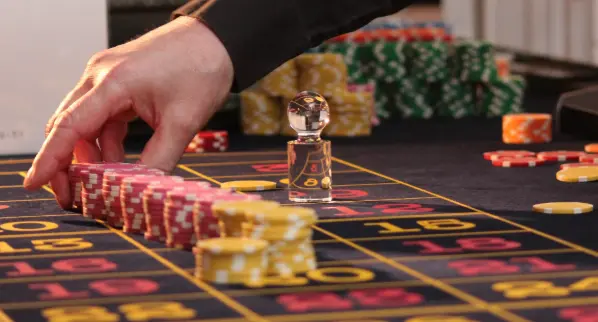
The Ace-King Trigger Threshold
The dealer only peeks when showing an Ace or a King. That is it. No other upcard triggers the inspection. This is not random house behavior — it is a hardcoded rule that shifts the conditional probability of the dealer qualifying from roughly 56% down to a razor-thin margin when that Ace or King hits the felt. The house edge lives and breathes inside this asymmetry.
Here is the brutal math: when the dealer shows an Ace, the probability they hold a qualifying hand (Ace-King or better) jumps to approximately 41.6%. When showing a King, it drops to about 28.7%. But the real killer is what happens when they do not qualify — you get paid even money on your Ante and your Raise bet pushes. That push is where Caribbean Stud dealer peek strategy either rewards you or bleeds you dry.
Why the Peek Exists at All
Casinos do not peek out of generosity. They peek to protect themselves from paying raise bets on hands where the dealer cannot qualify. Without the peek, a player could raise aggressively on every Ace or King upcard knowing the dealer might not qualify, creating a player edge. The peek eliminates that exploit by revealing dealer qualification before the player commits additional money.
This is a dealer peek mechanism designed to neutralize information asymmetry. The dealer looks, and if they do not qualify, your raise bet is returned. If they do qualify, the hand continues and you are locked into the raise. That locked-in moment is where the house edge crystallizes.

The Qualification Probability Matrix
Dealer qualifies with any pair or better, plus Ace-King high. That means the dealer fails to qualify roughly 43.4% of the time overall. But when that Ace or King upcard appears, the failure rate collapses. The peek transforms a probabilistic guess into a binary outcome before you have a chance to adjust.
Players who understand the peek exploit it by adjusting raise sizing based on upcard. Against a King upcard, the dealer fails to qualify more often, making a fold on marginal hands statistically defensible. Against an Ace, the qualification rate spikes, and raising with anything less than a pair becomes a donation.
Hardware and RNG Implications
In electronic Caribbean Stud variants, the peek is not a physical action — it is an RNG subroutine that evaluates the dealer's hole card against the qualification threshold before rendering the raise decision interface. The algorithm runs the check in microseconds, but the mathematical consequence is identical to a physical peek.
Some offshore platforms have been caught skipping the peek logic entirely in their RNG seed cycles, creating exploitable windows where players could raise without qualification risk. Those windows are audit failures, not features. The dealer peek is non-negotiable in any legitimate Caribbean Stud deployment.
The Raise Decision Window
Once the dealer peeks and qualifies, your raise is committed. No take-backs. The window between the upcard reveal and your raise decision is the only moment where player strategy actually matters. Everything before is Ante, everything after is resolution. The peek collapses that window into a binary trap.
Sharp players track upcard frequency and qualification rates across sessions. When an Ace hits and the dealer qualifies six times in a row, that is not variance — that is a signal the RNG is running hot on qualification. Adjust raise thresholds downward immediately. The peek does not lie. The math does not care about your feelings. 😤